Have you ever felt so overwhelmed by stress that you wanted to scream? Or so completely drained by anxiety that you just shut down?
If so, your nervous system was likely moving outside its Window of Tolerance.
The Window of Tolerance, a concept developed by psychiatrist Dr Dan Siegal, helps us understand how our nervous system responds to stress. It describes the space where we are most able to think clearly, stay connected and cope with life’s ups and downs.
Rather than seeing anxiety, overwhelm or shutdown as something that is “wrong” with you, the Window of Tolerance gives us a map. It helps us understand what our nervous system is doing and why. Once we begin to find our way around the map, we can better understand ourselves with compassion and discover what helps us return to safety, connection, and balance.
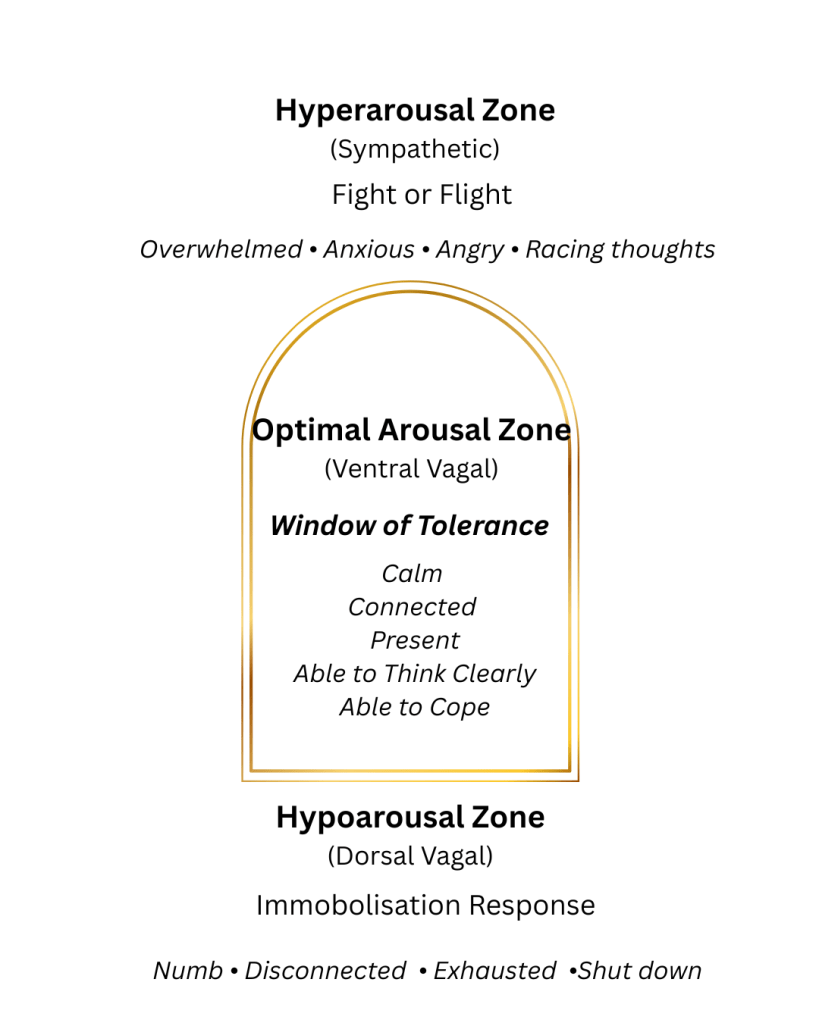
Our nervous system is always working in the background to keep us safe. The Window of Tolerance has three zones – Optimal Zone (inside the window; Hyperarousal (above the window; Hypoarousal (below the window). Depending on the stress you are facing, you will find yourself in one of the three zones.
Hyperarousal: Above the Window:
When stress or anxiety pushes you above your window, your body enters “fight or flight” mode. Your nervous system is flooded with adrenaline, tricking your brain into thinking you are in immediate danger.
How it feels: Anxiety, panic, racing thoughts, restlessness, and sudden anger.
Physical signs: A racing heart, shallow breathing, muscle tension, and a tight chest.
The Optimal Zone: Inside the Window
This is your baseline state of safety, calm, and connection. In this zone, your brain and body know that you are secure, allowing you to be emotionally flexible and mentally clear.
The Power of Connection: When you are in this zone, you can truly connect with others. You can listen deeply, feel empathy, communicate your needs clearly, and accept comfort from loved ones.
How it feels: Grounded, present, resilient, and relaxed. You feel comfortable in your own skin and capable of experiencing both joy and sadness without losing your footing.
Capabilities: Your logical brain stays fully online. You can think creatively, solve problems, and handle setbacks without spiralling into panic or despair
Hypoarousal: Below the Window
When distress becomes too heavy or lasts too long, your nervous system protects you by shutting down into “freeze” mode. Your body drastically slows down its energy to conserve strength.
How it feels: Emotional numbness, depression, exhaustion, loneliness, and brain fog.
Physical signs: Low energy, a flat voice, heavy limbs, and feeling “checked out” or disconnected from reality.
The Window in Action: A Real-Life Example
To see how these zones work, imagine having a tense disagreement or argument with your partner after a demanding day:
If you are Above your Window (Hyperarousal): Your system interprets the disagreement as an attack. Your voice raises, your heart rate spikes, and your thoughts race with defensive comebacks. You might feel a powerful urge to slam doors, yell, or abruptly storm out of the room.
If you are Below your Window (Hypoarousal): You completely shut down. As your partner speaks, you might stare blankly at the wall, feel a heavy fog roll into your mind, or find yourself nodding along without processing the words. You feel entirely numb, emotionally disconnected, and unable to articulate any thoughts.
If you are Inside your Window (Optimal Zone): You still feel the discomfort and hurt of the argument, but you remain anchored. Your thinking brain stays online. You can pause, take a breath, express your feelings honestly without attacking, and truly listen to their perspective to find a resolution together.
When you feel yourself slipping out of your optimal zone, you can use these simple somatic (body-based) grounding techniques to signal safety to your nervous system:
To Soothe Hyperarousal (Bringing Yourself Down)
The 5-4-3-2-1 Method: Look around you and name 5 things you can see, 4 things you can physically feel, 3 things you can hear, 2 things you can smell, and 1 thing you can taste. This pulls your mind away from racing thoughts and anchors you in the present moment.
Elongated Exhales: Take a deep breath in through your nose for a count of 4, and exhale slowly through your mouth for a count of 6 or 8. Longer exhales instantly trigger your parasympathetic nervous system to slow down your heart rate.
To bring yourself back from Hypoarousal
Physical Movement: Gently stamp your feet on the floor, stretch your arms over your head, or roll your shoulders. Physical movement helps send energy back into heavy, frozen limbs.
Sensory Stimulation: Splash cold water on your face, hold an ice cube in your hand, or wrap yourself in a textured, weighted blanket. Strong physical sensations gently wake up a numb mind and body.
Everyone’s window of tolerance is a different size. If you experience prolonged stress, grief, burnout or past trauma, your nervous system adapts to protect you and keep you safe from further pain, it narrows your Optimal Zone window.
When your window is small, even minor daily conveniences can easily throw you off balance. You might find yourself snapping in anger or completely withdrawing from loved ones over something small.
Leaving your Window of Tolerance is not a personal failure. It is your nervous system doing its best to protect you.
The good news is that your window of tolerance is not fixed. Thanks to your brain’s natural ability to adapt and heal, your window can grow wider and more resilient over time.
In our counselling sessions, the aim is not to avoid stress entirely, but to expand your window so you can handle life safely and confidently. Together, we will:
Identify your unique early warning signs before you fully exit your optimal zone.
Practice customized tools to soothe panic or gently wake up your system from a freeze to bring you back to safety and connection.
Process and safely address the underlying memories, stressors, or traumas that keep your window narrow.
Begin to build resilience by widening your window so you can experience a full range of human emotions while staying firmly grounded.
You do not have to navigate these overwhelming highs and lows all by yourself. We are here to help you find firm ground again.
Where do you notice yourself most often – above, below, or within your Window of Tolerance?
Mosaic Counselling
Piecing Lives Together 🌿

